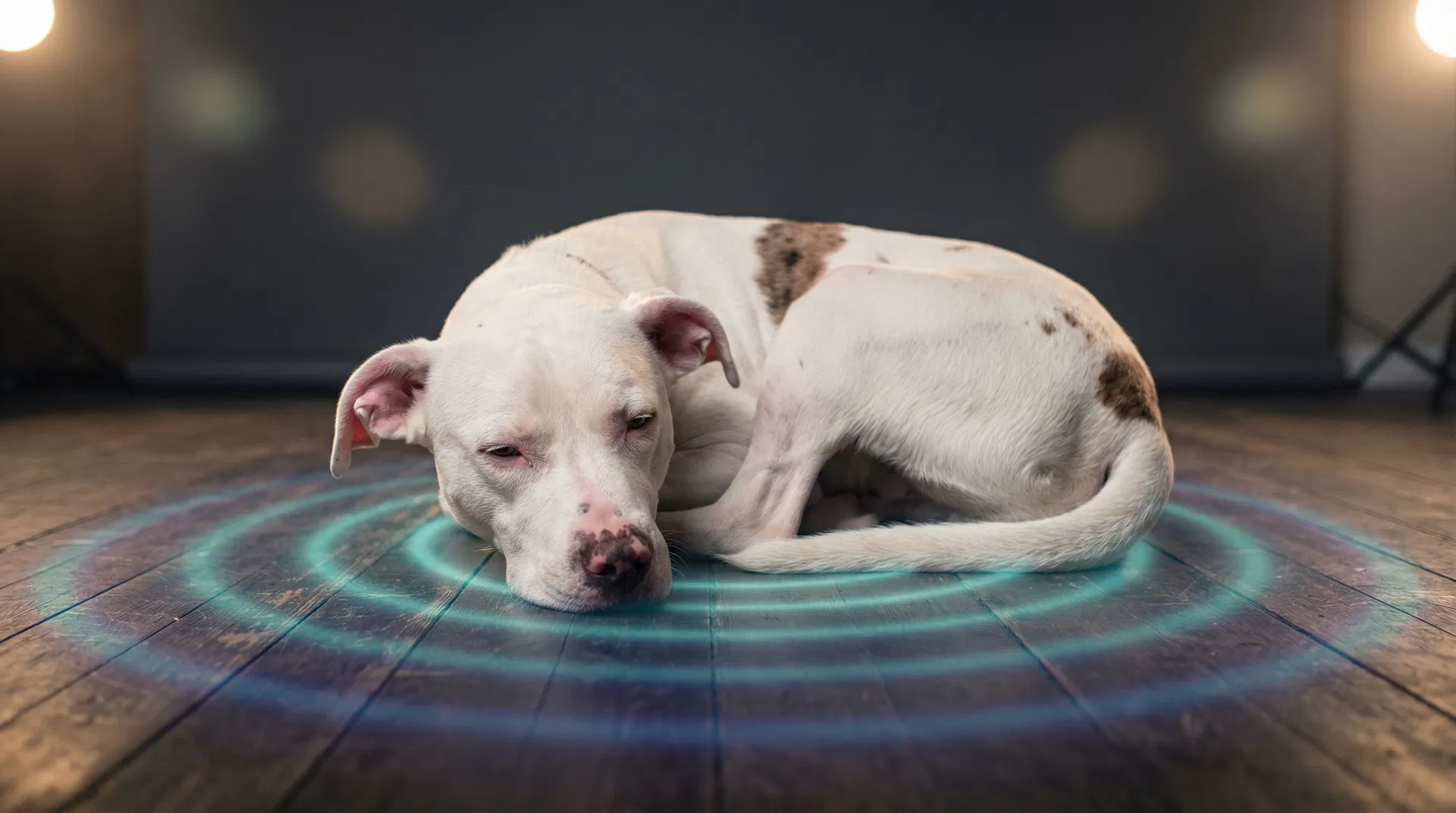

Healing Through
Vibration
A scientifically engineered vibrotactile therapy protocol created for Axel — a completely deaf dog with anxiety. Six frequency layers, felt through the body, not the ears.

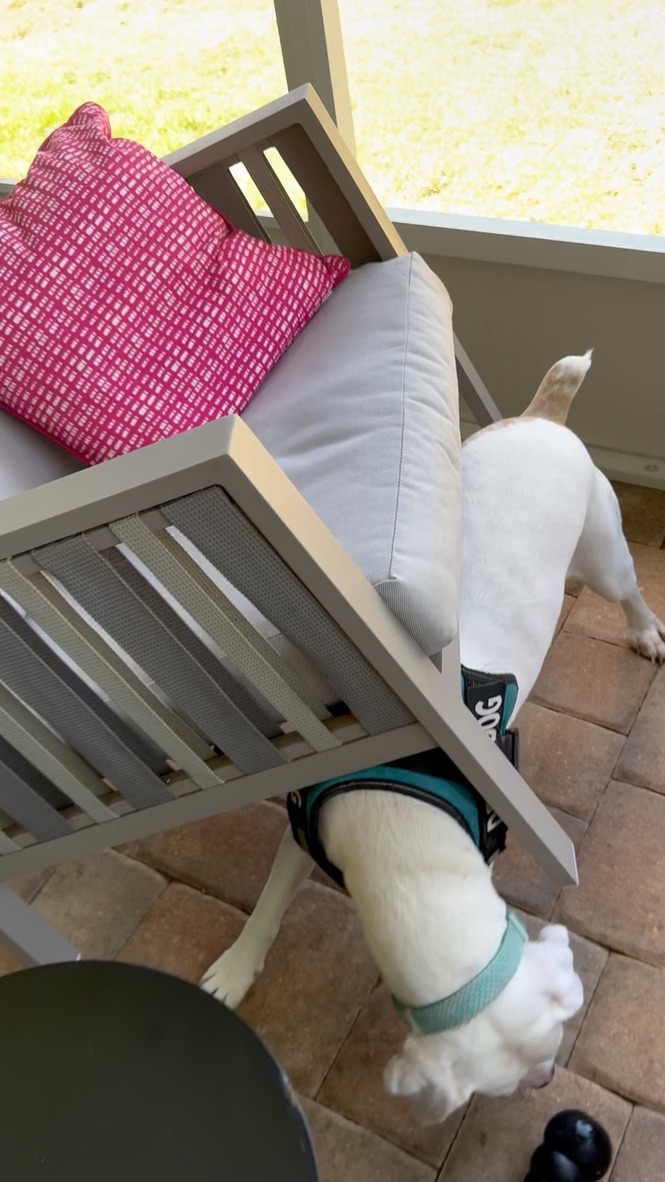
Axel
Deaf5-year-old male Catahoula mix · Pink eyes, nose & ears · Brown spots · Mostly white with distinctive markings
How a Deaf Dog Feels Sound
When a dog is completely deaf, traditional auditory therapy is bypassed. But the body remains deeply receptive to vibration. This protocol delivers healing frequencies physically — through the floor, the bed, and the skeletal structure — activating pathways that hearing cannot reach.

Bone Conduction
Low-frequency vibrations travel through solid surfaces into the dog's paws and skeleton, reaching the vestibular system and inner ear structures that remain intact even in deaf dogs.
Vagus Nerve Activation
Rhythmic vibration stimulates the vagus nerve — the body's primary parasympathetic pathway — triggering the 'rest and digest' state that lowers heart rate and cortisol.
Brainwave Entrainment
Specific frequencies cause the brain's electrical activity to synchronize with the external rhythm — shifting from anxious beta waves to calm theta and delta states.
Explore Each Healing Track
The session is composed of six simultaneous frequency layers, each targeting a different physiological pathway. Tap any track to reveal the full science behind it.
Grounding Pulse
20–40 HzSub-bass sweep felt through the floor and body
Heartbeat Rhythm
72 BPMAutonomic entrainment to a calm resting heart rate
Solfeggio Resonance
528 Hz + 432 HzThe Love Frequency — cortisol down, oxytocin up
Delta Isochronic
3 HzDeep healing brainwave state — rest and repair
Theta Gateway
7 HzCalm, meditative awareness — reduces reactivity spikes
Brown Noise Base
< 200 HzNatural earth resonance — continuous full-body grounding
Begin the Therapy Session
Press play and place your speaker on the floor or against your dog's bed. The healing begins the moment the vibrations reach his body.
Vibrotactile Calming Protocol
10-minute therapeutic session · 6 frequency layers
Important: For maximum benefit, play through a subwoofer or bass speaker placed on the floor or directly against his resting surface. The sub-bass frequencies (20–40 Hz) must be physically felt, not just heard.

How to Administer the Therapy
The delivery method is as important as the frequencies themselves. Follow these steps to ensure your dog receives the full vibrotactile benefit.
Choose Your Speaker
Use a subwoofer, bass-heavy Bluetooth speaker, or a tactile transducer/bass shaker attached to his bed. The key is that the low frequencies must be physically felt, not just heard.
Set the Volume
Place your hand on the floor or his bed while the track plays. You should feel a gentle, steady vibration — like a purring engine. Not loud enough to rattle objects.
Build the Association
For the first week, play the track once daily while he is already calm, pairing the vibration with a high-value treat. This builds a positive Pavlovian association with the sensation.
Use Proactively
Play the 10-minute session when you notice early signs of pacing, or immediately before known triggers (heavy wind, visitors). Consistency builds cumulative benefit over 2–4 weeks.
Friendly Cues During Session
Pair these gentle, visual hand signals with the vibrotactile session to reinforce calm behavior and deepen your bond. Each cue communicates safety, approval, and trust — the language your dog can actually see.

Arms wide like a welcoming hug
Reward: Favorite treat once they react to your presence
Signals safety and warmth — "You are safe with me."

Dog Sign Language — "Yes! Good boy!"
Reward: Favorite belly rubs or ear scratches
Your visual "clicker" — marks correct calm behavior instantly.

Paw meets palm — mutual connection
Reward: High-value reward (chicken, cheese, favorite toy)
Builds trust and engagement through intentional touch.
Signs the Therapy Is Working
Monitor these physiological and behavioral indicators to track your dog's progress. Improvements typically emerge within 2–4 weeks of consistent daily sessions.
Respiration Rate
Transition from rapid, shallow chest breathing to slow, deep abdominal breathing within 5–10 minutes of session start.
Posture Softening
Relaxing of the ear base, softening of facial muscles, and 'settling' of the hips from a standing/pacing position to lying down.
Bladder Control
Over 2–4 weeks of consistent use, an increase in the time between urgent bathroom needs as anxiety-induced frequent urination decreases.
Reactivity Window
A measurable delay between encountering a trigger (wind, animals, people) and the onset of reactive behavior — indicating improved impulse regulation.
Pacing Duration
Reduction in total daily pacing time. Track by noting how quickly he settles after the session begins.
Heart Rate
If you can measure resting heart rate (normal range: 60–140 BPM for dogs), look for a 10–20 BPM reduction during and after sessions over time.
The Best Speakers for Axel
The right speaker is the difference between Axel hearing nothing and feeling everything. You need a speaker that produces strong sub-bass below 40 Hz. Here are the best options at every price point, available in-store and online.
JBL Boombox 3
Best Buy, Target, Walmart
Reaches exactly 40 Hz — the critical threshold for Axel to feel the Grounding Pulse layer. Massive passive radiators on both ends create strong floor vibration. Place it flat on the floor next to his bed.
- Goes to 40 Hz (ideal for therapy)
- Passive radiators produce strong floor vibration
- Portable with rechargeable battery
- Available at Best Buy and Target
Pro tip: Set it on the floor, not a shelf. Floor contact amplifies the vibration Axel feels through his paws.
Anker Soundcore Motion Boom Plus
Best Buy, Amazon, Walmart
80W output with two large woofers produces substantial low-frequency vibration at a fraction of the JBL price. BassUp technology intensifies the sub-bass in real time.
- 80W output — very loud and vibration-strong
- 24-hour battery life
- Under $100
- Available at Best Buy
Pro tip: Enable BassUp mode in the Soundcore app to maximize the low-frequency output for Axel.
Dayton Audio BST-1 Bass Shaker
Amazon
A tactile transducer — not a speaker, but a vibration motor — that bolts directly to the underside of Axel's bed or mat. Converts the audio signal into pure physical vibration. Axel feels 100% of every frequency layer directly through his body.
- Attaches directly under his bed or mat
- Reaches 5 Hz — far below any speaker
- No sound output — pure vibration only
- Pair with Nobsound NS-01G Mini Amp (~$25)
Setup tip: Screw the shaker to the underside of a wooden board placed under his bed. The firmer the surface, the stronger the vibration he feels.
AuraSound AST-2B-4 Pro Bass Shaker
Amazon
The original professional-grade tactile transducer used in home theaters and sound therapy. Extremely effective at converting low frequencies into physical vibration. Widely recommended in sound therapy communities.
- Under $40
- Professional grade quality
- 5 Hz floor — deepest range available
- Lightweight and easy to mount
Setup tip: Place it in a small wooden box or mount it under a firm dog bed. The firmer the surface it is attached to, the stronger the vibration Axel will feel.
Quick Comparison — What to Search For
| Speaker | Price | Where to Buy | Bass Floor | Best For |
|---|---|---|---|---|
| JBL Boombox 3 | ~$350 | Best Buy / Target | 40 Hz | Plug-and-play, no setup |
| Soundcore Motion Boom Plus | ~$100 | Best Buy / Amazon | ~45 Hz | Best value, in-store |
| Dayton Audio BST-1 | ~$55 + amp | Amazon | 5 Hz | Maximum effectiveness |
| AuraSound AST-2B-4 | ~$35 + amp | Amazon | 5 Hz | Budget professional grade |
Search tip: If shopping online, search the exact product name on Amazon or Google Shopping. For in-store, call your nearest Best Buy and ask: "Do you carry the JBL Boombox 3 or Soundcore Motion Boom Plus?"
Scientific References
Iaccarino, H. F., et al. Gamma frequency entrainment attenuates amyloid load and modifies microglia. Nature, 2016.
Castillo Escotto, G. Changes Detected in EEG and HRV in Healthy Dogs After Transcutaneous Vagus Nerve Stimulation. University of Guelph, 2022.
Akimoto, K., et al. Effect of 528 Hz music on the endocrine system and autonomic nervous system. Health, 2018.
Teo, J. T., et al. Use of portable devices to measure brain and heart activity during relaxation. International Journal of Psychophysiology, 2023.
Lindig, A. M., et al. Musical Dogs: A Review of the Influence of Auditory Enrichment on Canine Health and Behaviour. Animals, 2020.
Munro, K. J., et al. The effect of head size on bone conduction brainstem auditory evoked response in canines. Veterinary Audiology, 2018.

Ohh My Dog!
This vibrotactile therapy protocol was developed by Caroline, founder of Ohh My Dog! — a dedicated pet care business based in the Sarasota/Bradenton area of Florida. Inspired by Axel, a completely deaf Catahoula mix with anxiety, this protocol is now available to help other dogs with similar challenges.
If your dog experiences separation anxiety, fears traditional boarding facilities, or has special needs — Caroline will provide a unique & personalized pet care service for your pet.
Axel's personality Therapy time
 Before therapy